
What is Process Mapping in ISO 9001?

What is Process Mapping in the Context of ISO 9001?
Process mapping can be described as the practice of visually representing how work flows through your organization. This is everything from input to output, including responsibilities, decision points, system support, and requirements. Instead of lengthy written documents, you use process mapping (i.e, flowcharts or diagrams) to create clear and understandable models describing your procedures.
Under ISO 9001, clause 4.4, organizations are required to “determine the processes needed for the Quality Management System” and understand their interactions. Here, process mapping helps you to:
- Identify all core processes and their dependencies.
- Visualize responsibilities and resources.
- Highlight how each process contributes to delivering quality products and services.
Benefits of Visualizing QMS Workflows
So, what are the actual benefits of process mapping within your work with ISO? Well, there are loads of benefits, even beyond compliance:
- Improved Compliance and Audit Readiness
Auditors love clear evidence. A well-documented process map quickly demonstrates how you meet ISO 9001 requirements. Read more about Zurface journey and their ISO audit in this customer case. - Identifying Risks and Inefficiencies
Mapping your workflows helps you discover bottlenecks, redundant steps, or risks that could impact quality. Read more about process-based risk analysis here. - Better Communication Across Teams
Visual tools make it easier for employees, managers, and stakeholders to share a common understanding of the QMS. Everybody understands what the other person does and how it affects you. - Foundation for Continuous Improvement
Once your processes are mapped, you can analyze and improve them systematically, aligning with ISO 9001’s Plan-Do-Check-Act.
How to Create Process Maps Compliant with ISO 9001: Step-By-Step
An ISO project can sometimes feel overwhelming, especially starting from a clean slate. Where do we even begin? The best way to start is through an approach we call IRPO, which stands for Interested Party model, Relationship model, Process model, and Organizational model.
- Identify the stakeholders
We start by identifying the business’s stakeholders by creating an Interested Party model to gain an understanding of what stakeholders the business has to relate to.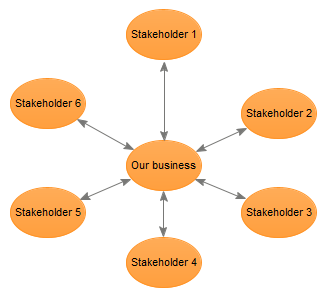
- Define your relations with your stakeholders
Once the stakeholders are identified, we can use a Relationship model to visualize and describe the relationship we have with each specific stakeholder. Therefore, we have visualized the needs, demands, and the information exchanged between the business and the interested parties. This information is later used to identify which processes need to exist to meet the stakeholders’ requirements and needs.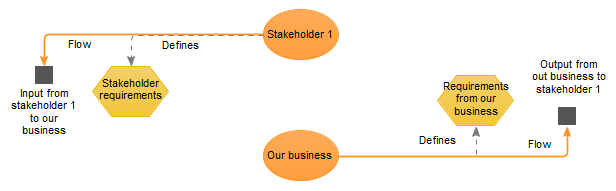
- Identify Your Management Processes, Core Processes, and Support Processes
Time to identify our processes. We start with the high-level processes that directly affect our products/services. These are categorized as:
– Management processes: How do we plan to follow up on our operations? These processes could simply be called “Plan” and “Follow up”, and aim to describe, step-by-step, how we plan and follow up on our business.
– Main processes: How do we meet the requirements and needs of our stakeholders? This could, for example, be the “Sales process”, the process of “Developing Solutions”, or “Delivery”.
– Support processes: What supporting processes are required to ensure effective operations? These processes could, for example, be “Manage employment”, “Manage purchases”, or “Develop and Maintain IT-environment”.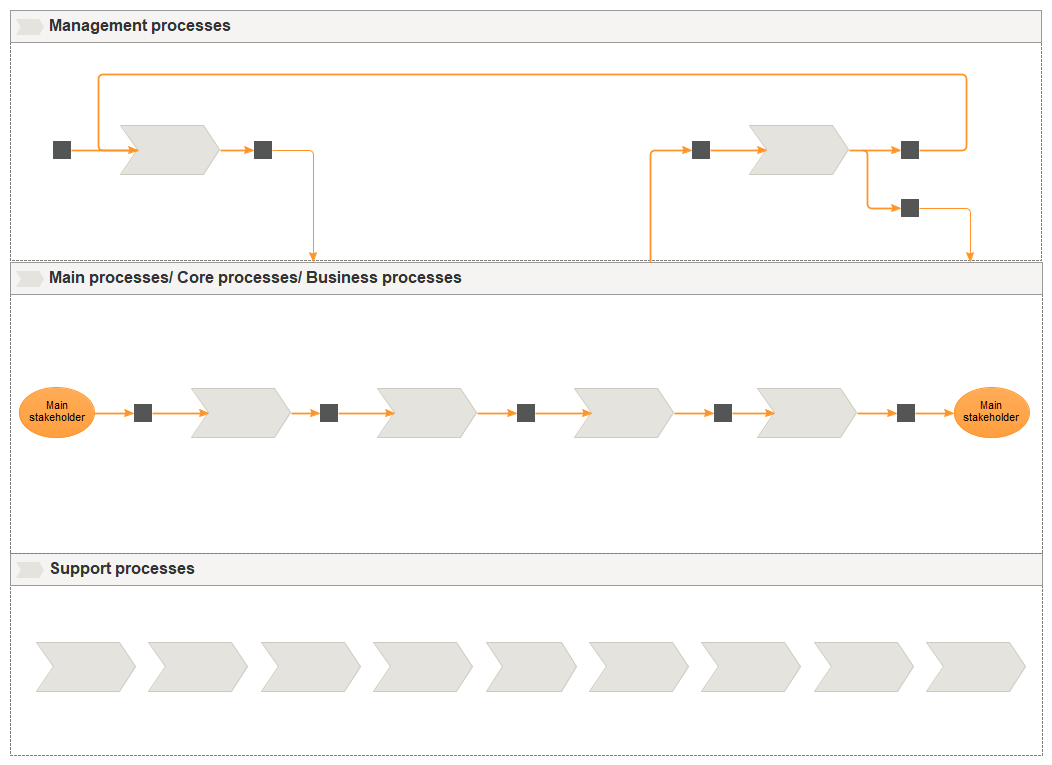
- Connect the Dots and Start Mapping
Now that we have identified our different processes at a high level, it’s time to connect them. This is done by visualizing their corresponding inputs, outputs, and relations.
– Inputs: describes what triggers the process.
– Outputs: what’s delivered at the end of the process.
– Relations: represent the flow or connection between two processes.
This provides us with a solid foundation to understand how everything fits together and how processes interact, as emphasized in ISO 9001.
- Delve Deeper
Now that we have our high-level process map created, it’s time to break down each process. Depending on the level of detail we want to provide, we can add levels of breakdown to our maps. This is where we begin adding roles, defining responsibilities, and addressing the ISO requirements imposed upon us. A key takeaway from this step is to involve the right kind of people. Those are the ones who actually know how the procedures are performed.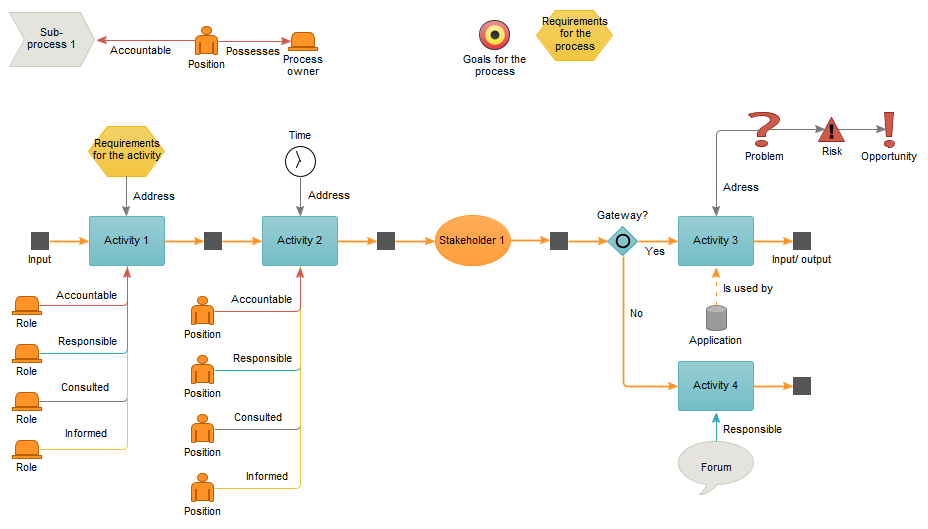
- Clarify responsibilities
Once we have visualized the types of responsibilities within our processes, we can clarify their location within our organization. This is done by using the Organizational model. The responsibilities are specified in terms of roles and positions.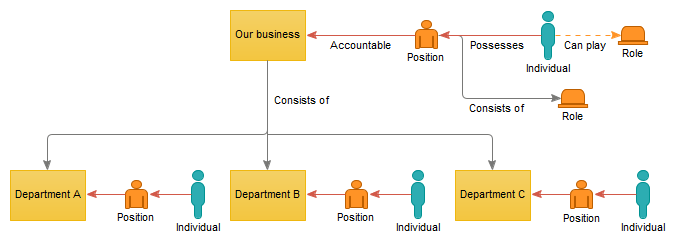
- Share the Maps with the Organization, Educate Staff, and establish ISO 9001
Once the major achievement of mapping all of your processes is done, it’s time to share the result with the organization. This ensures that everyone knows the content of the QMS. A significant aspect of the ISO 9001 audit involves ensuring that employees are familiar with and consistent in their task performance.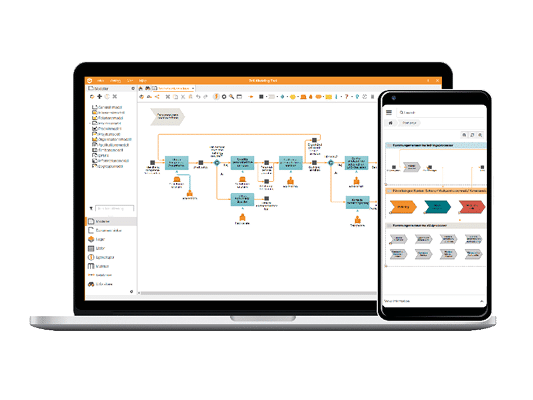
- Keep the QMS Alive
Your QMS should be reviewed and updated whenever the processes change. A frequent internal audit also aligns with ISO 9001’s Plan-Do-Check-Act.
Tools for Process Mapping
Process mapping can, in theory, be performed in various ways. For example, documented as text in documents or simply visualized in different drawing tools. However, an easy-to-use business modeling software can significantly improve both the project and the outcome.
Conclusions: Make ISO 9001 Easier with Visual Workflows
Compliance with ISO 9001 isn’t just about satisfying auditors; it’s about building a system that helps the organization to thrive. Process mapping turns your QMS into a living, visual framework that is much easier to understand, manage, and improve. Beyond a certification, you’ll gain a deeper knowledge of your operations that will benefit you in reaching your goals.
By investing time and selecting the right software for mapping your processes, you’ll not only meet ISO 9001 requirements but also gain a competitive advantage in terms of efficiency and effectiveness, as well as in transparency and customer satisfaction.
FAQ
The standard requires organizations to identify, understand, and improve their processes. Process mapping allows you to visualize your processes, making them easier to understand and improve.
In 2c8 Apps, you can link ISO requirements directly to the processes or activities where they are addressed. You can then generate lists and matrices that give you a clear overview of all requirements and how you are complying with them.
Yes, in 2c8 Apps, you can easily combine multiple standards into a single visual management system. Read more about how our customers have obtained certification for several standards by clicking here.
Absolutely. Clear process maps make it easy to show and explain how you meet ISO 9001 requirements and provide auditors with concrete evidence that processes are understood and controlled.
Yes, a large part of ISO certification is about continuous improvement. In 2c8 Apps, it is easy to manage and develop your processes over time. It also supports employees in their daily work and makes onboarding much smoother.
Book a demo
Do you want to know more about the possibilities in 2c8 Apps?
2c8 Apps is a powerful modeling tool used in various areas of application. Book a demo and explore the possibilities of 2c8 Apps.
- Book a free 30-minute demo.
- Walk-through of the software.
- Ask us anything.